Thursday, June 24, 2010


Ship


But this is a mess. I need some structure. We need structure.

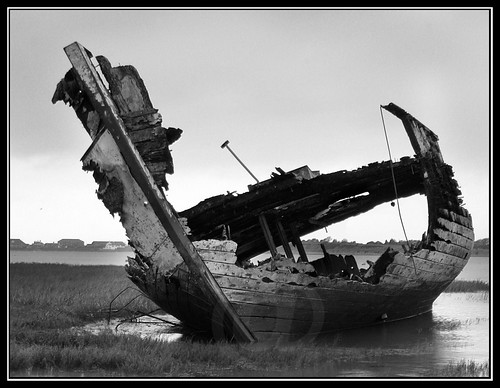
Help me dredge up the structure of this old boat from the bottom of the ocean. This algaed carcass of a ship, for years a playground for the fish, will structure my story. Help me drag it from the depths and as we heave, I’ll tell you some things. Listen.

I wish I could speak but dyspepsia holds my tongue. I feel such a weight of tales, such a full stomach of words that I might vomit you a whole book, a library of ink.

Be patient. I will get there.

This boat – and we are heaving it, yes we are – is drippingly emerging from the clouded waters. Heave ho. And your muscles are strong. You are a good heaver. You tug like a veteran ship salvager. But keep your focus and I shall sing.

My song will keep our sinews well oiled. Oh look at the proud old ship! Even its drying drips are wondrous. Look how it retains its glory even after so many years entombed in that liquid Hades. But I was going to sing. I will sing.

Heave hoe, the reaper mows
And as he goes with timely blows
The wheaty ears are blasted.

Heave hoe, the gentle mice
Like scuttling lice, or rolling dice
Flee full-tummed unfasted.

Heave hoe, those earthy greens
Do still beteem, by nature’s wean
Ne’er letting death hold sway

Heave hoe, on nature’s road
Some will be toads, some sing fair odes
And some will do what may

As this old wooden beast gains its renaissance into air we smell its salty promise... while my promises of tales to charm your ears remain yet unfruited. I must needs stop stopping and get on with starting to start. So stand back.

No, not so far back as you can’t hear me over the roar of the creaking vessel (as it inches glacier-like). Thats right, legs firm and keep up your tugging, for I can feel the start of a tale coming on. And what a tale I have to tell.

Oh but look how the gulls - how they hover and swoop, plunging their beaks into the marine foliage, replete as it is with the bugs and mites of the deep. From this uprooted civilisation they pluck in their beaks the spongy, slimy creatures whose eyes, if they have them, are blinded by the first-time-seen sun, and whose lungs, if they have them (or something like them) are drowned in the caustic breezes of the super-marine world. Dazzled and shocked, these wrigglers squirm and recede, trying to hide clam-like in the algal sludge which this doting ship wears like a dressing gown. But plucked they must be, for the gulls are hungry and have no mercy on this chewy treat, no sorrow for this rare and delicious game.

I should focus. You should check me in my digressions. I grow old. Indeed, I forgot myself and my professed readiness to tell tales. I saw the elegant gulls and forgot myself. But you can forgive me, can you not? These gulls playing and pecking at the whale-like hulk: few sights have entered my eyes so majestically. Surely the wide-eyeing majesty of the Now – and not just any now, these gulls, this particular compelling Now – trumps the dustiness of the Used-to-be. Who can cast their thoughts into the distant land of past events? – Who can do this when muscles wrench at a thousand ropes and chants of “heave” have scarcely fallen dumb when they return with redoubled potency, when a historic floating beast of old rears its sleepy head at our cajoling tuggery?

But lo! The Now strikes again – look! The cavernous underbelly of the ship revealed, slowly rising from the water, and we see inside the cabins. A shabby cross section washes into view, rotten timber fallen away here and there to reveal glimpses of the domestic innards. Is that not an old desk, three legged with age, carbuncled with the many kisses of the subaqueous salts? Yes, by jove! An old desk! How startling to see such a familiar thing so changed, do long dunked and forgotten in the colossal bucket of the seas.

But forgotten no longer. We remember you, oh joyous desk of old. It is broad and sturdy, even in its ruined posthumos-ity. I’d wager these were the captains quarters! What think you on’t? And what treasures might there be, of gold and olden silver, of faraway climes and lost tribes. I tremble just to think.

But that was my tale, I see it now. It crept in under the door, all stealth. I’ve told my tale. All the while stopping and starting, ever digressing and circumambulating. But it seeped through - a crafty osmosis! The beans are spilled. The cat is out.

The sprightly goblin dances no more (nor jives the goblinly sprite!)

You see: I told it all in the not-telling. I spoke it in the nods and winks, in the gaps, in nonsense. It was between the lines - between the ropes!

Words but grab at meanings true
Feeble in their violence
Living holds the flowing you
And the rest is silence.

Tuesday, June 22, 2010


Pangrams


A pangram is a sentence that uses all of the letters of the alphabet. The most famous English one being “the quickbrown fox jumps over the lazy dog”. For pangrammatists the ultimate quest is to find a sentence that contains each letter only once. This is known as a perfect pangram. There are a few in English but they make very little sense to anyone but the most absurdly well-dictionary-read lexophile. Here are two examples of perfect English pangrams, with explanations of the meanings in brackets below:

· Cwm fjord bank glyphs vext quiz.

(Carved symbols in a mountain hollow on the bank of an inlet irritated an eccentric person.)

· Squdgy fez, blank jimp crwth vox!

(A short brimless felt hat barely blocks out the sound of a Celtic violin.)

These perfect pangrams may strike most people as ridiculous and pointless achievements but as they become slightly longer, letting in some repeated letters, the hunt for pangrams produce some wonderfully odd sentences that we might never otherwise have the pleasure of considering. Take for example this Bulgarian pangram:

За миг бях в чужд плюшен скърцащ фотьойл.

(For a moment I was in someone else's plush squeaking armchair)

Or this French one:

Voix ambiguë d'un cœur qui au zéphyr préfère les jattes de kiwis.

(Ambiguous voice of a heart which prefers dishes of kiwis in the breeze.)

It seems to me, though I am very likely indulging myself in a ridiculous thought, that if they contain every letter in the alphabet then they must be saying something universal. If they are built of every type of particle in the known communicative landscape, surely they will be a kind of unifying patchwork quilt of representation that speaks of and for all the letters, for the language, for that culture’s communication itself. If you look deep enough into the pangram you will see an entire culture. Its reverberations will ricochet out of it from every letter like a thousand balls bouncing madly out of a swirling arrangement of ink. The typography of an alphabet itself, which will be necessary for it viewing (though even Braille has a design!) already gives away loudly whispered secrets of the culture. Look again at your language in its most reduced form, a single letter. Look at the tincture of a word, the letter a. Look at its handsome form, and how the ink curls about it lovingly. This is the ink’s favourite pastime, indeed, its passion. Ink loves nothing more than to form letters on the page. When we form a word in our mouths and on our faces the explosive complexity is of course to be celebrated. But ink lives for text. ‘Words dazzle and deceive because they are mimed by the face. But black words on a white page are the soul laid bare’ Guy de Maupassant.

Our words dip their bare feet in ink buckets and walk the papers of our diaries. Our thoughts leave inken footprints. And where there is no ink, our thoughts must leave some marks somehow. Just as Ahab’s peg leg leaves dents in the deck, his thoughts of Moby Dick bechisel his forehead:

‘Soon his steady, ivory stride was heard, as to and fro he paced his old rounds, upon planks so familiar to his tread, that they were all over dented, like geological stones, with the peculiar mark of his walk. Did you fixedly gaze upon that ribbed and dented brow; you would see still stranger footprints – the footprints of his one unsleeping, ever-pacing thought.’

-Herman Melville, Moby-Dick.


Idleness


Idleness is, I think, our greatest passion. Industry is, surely, a disease. It is an itch upon our souls. A lolling rest is what best suits us; a sated, head drooping, floppy-bodied decumbency. So why am I not taking advantage of my freedom and lolling in some corner in worship to this ideal (or idleal, you might say, but this tongue-challenge may be too much effort for a true idler) why, you might ask, am I sat defiantly upright at the computer tapping away in a frenzy when I could be lazing in any number of positions elsewhere? Well, I’ve caught the disease. I’ve got the itch. I’m a sufferer of the animating impulse that drags our yawning souls from rest and pokes them into action, shoots at their feet to make them dance, showers them in itching powder that causes an itch so dire that it can only be relieved by a most furious industry. So here I am, writing. Un-idled.

But not for long, I feel my gut murmur, not for long will you toil. No? I question. But I can’t help it. Even when I resign myself to a stretch of relaxation, a period of placid inaction, the itching begins and how smart a lash that whip can give. No sooner have I leaned back on a sofa, gazed off out the window and let my eyelids do what they will, than the distant sound of a conceptual police siren can be heard, buzzing about my innards. These police live in my psyche and it is their chief aim to keep me as busy as possible. This, they believe, if they can be said to believe anything, is the finest state for a body to be in: industry, toil, labour, action. Couched in the depths of my unconscious they rest their bones when I am in toil, or they sit about playing cards in the station kitchen, brewing endless teas and coffees, discussing the weather in monotones of wagging insouciance.

But when I try my hand at this, when I even think of such loose behaviour, lights and buzzers begin to flash and whirr on their dashboard and they drop their cards mid-hand, leaping up into sanctimonious alert. Drinks are left to steam themselves out of desirability, hammocks hang inert, and cards fade in the cultural vacuum of ruler-less splay. Into their cars they leap and out of the murk they drive, out into my conscious mind they venture with powerful flairs, megaphones and placards, with harpoons, guns and grenades. They’ll do anything to wake me from my stupor and prick me into action. A modern day Gulliver I have become, whose Lilliputian superego plagues him from the inside in systematic formation. A single ant is as ineffectual as a single member of this constabulary. But just like ants, these officers of my psyche can get to work with marvellous potency when they work in concert. It is unbearable. I feel like the captain of a ship whose deceased mutinous crew have, ghost like, inhabited his body and are driving him which way they will.

So I don’t let myself idle much. It keeps them happy. Instead, I urge myself on. I whip myself inwardly, thrash my hide viciously, lest I become complacent and start to linger or loiter over some trifle. Yes, I beat myself up. As the anarchists like to joke “Help the police: Beat yourself up”. They may joke about it but people do it. People really do. From the inside.

And time passes without a care in the world for what it passes. It simply strides on. It does shock me sometimes when I consider it. Time just keeps on ticking and tocking and moving forwards. There’s no stopping it. So staunch and unstoppable. It plows on without asking for or needing anyone’s permission, without any support. Whether you condemn it or make it an object of your worship, it trundles along like some massive whale whose immensity will not allow for any change in momentum. If you pay no attention whatsoever, on it goes.

Saturday, May 22, 2010


Originally uploaded by William Kraemer


“Tell the sky about itself – Make it know.”

“Just keep quiet, it knows already. Give it space to grow.”

“Isn’t it big enough already?”

“No”


When, at last, tomorrow is dawning
I’m crouched, brows furrowed,
In the burrow of morning.
Drowning in frowning king-uncrowning.

All passes under or over a bridge
All buzzes – feeble as a midge.

Then crouched when
It all happens again.


Having

To truly own a copy is to hold it in your head
To have it always in your memory – till your dead.

Books can line your shelves and overflow with brilliant words
But leave them all unread and they’re as good as lifeless turds

Having only each other’s company to smell and guess
What’s harboured in the books against whose shoulders they press.

I’m learning one by rote – written on a scrap of paper
I glance at it less and less until its second nature

To speak or think the poem to myself when I’m alone
This is what it really is – in purest form – to own.

Possessions, money, past events, and all other forms of art
Must remain aloof from capture – must remain apart.

Only poems can live inside us – fully formed – alive
In fact I think the more I learn it’s their best way to thrive.

Saturday, May 08, 2010


Something

I was sitting in the staff room – most people called it the smoking room – watching a game of pool. I wasn’t interested in the pool. I was just staring blankly ahead of me really, listening to a conversation across the room. There were two visiting machinists, contractors called in to fix or modify something in the warehouse, I don’t know. They were sat over there talking through the thick smoke at each other, arguing. One had a newspaper in his hand. He said ‘look, it says here: “Police traced him to Silvertown where he was, lost, found.” That’s what it says and I see no problem with it.’

The other man shook his head emphatically causing the smoke which hung in the air around him to swirl about lazily, like a dirty blanket in slow motion. ‘You don’t have a problem because you don’t know about proper usage,’ responded the head-shaker, ‘It’s not a grammatical error per se, it’s more a stylistic fault. Trust me. Listen: It should really say “Police traced him to Silvertown where he was found lost.” And that sloppy journalist should be fired.’

Later that day, after work, I was passing through the staff room and I found the newspaper discarded on a seat. Leafing through it, I found the article. It concerned the police’s dealings with what the journalist called a lunatic. Police had deemed him "possibly dangerous". Clutching a toy mobile phone with no tele-communicative power whatsoever, the deranged man was found in Silvertown, East London after supposedly following text messages directly from God.

His story, outlined in the paper, was for me a sad one. Neighbours and attentive locals in his home town of Putney, South West London, knew him as “the mobile phone man”. He was often to be seen darting frantically and unsystematically about the town centre, gazing intently at the screen of his mobile phone, always jealously clutched with both hands and held near his face. Initially no one had noticed that the mobile phone was fake – that it was a children’s toy. Many pointed out his startling ability to find his way without his eyes, as he dashed about without their help, never crashing into anything, ever gazing into the phone.

Now in Police custody, the deeply upset man insists that his phone regularly receives text messages from God, whom he calls His Mighty. ‘The texts’, he explained to Police, ‘range from simple demands or advice on how to act to cryptic messages, puzzles or kōans.’ But this man’s God is not quite Him of the traditional Judaeo-Christian tradition. Not quite omniscient, not quite omnipotent. According to the lunatic, who gave his name as Gavin Stegosaurus, God ‘is a Luddite... [and] not fond of sending text messages. But, reluctantly, He recognises that it is a supremely efficient way to get in touch. He doesn’t like texting because he can’t get the hang of the predictive function. He often makes mistakes.’ So despite being, according to Mr Stegosaurus, ‘almost perfect’, His Mighty is prone to typos. However, the article went on to explain, Mr Stegosaurus can never be sure if His Mighty has planted the typo on purpose to test him, or as a clue to something, or to illustrate the irrationality existence, or something else like that; or if it’s just a mistake.
Frantic and alarming as he is at first sight, the people of Putney’s familiarity with Mr Stegosaurus left him largely un-noticed by the authorities. It wasn’t until he was spotted darting around Silvertown in his customary way that the Police were alerted by many of Silvertown’s frightened locals, people un-used to his outlandish behaviour. He was then apprehended on the grounds of ‘frightening behaviour’ and brought back to the station. Explaining himself to Silvertown’s police he cited a text message he says he received yesterday stating simply ‘Run as east as you can’ (sic). Unsure whether it was a predictive-born typo (east being a predictive-synonymous of fast) or a clear and direct demand, Stegosaurus ran East for more than ten miles, ending up tired and flustered in Silvertown, East London. Having decided, he said, that Silvertown was “quite east enough thankyou”, he set about waiting for further instruction from His Mighty – and this is what scared the residents. His method of waiting for further instruction involves the aforementioned bizarre darting about.

I read this article standing in the smoking room after work. My stomach gave a little painful churn of empathy. I thought of the man, deluded and insane, with his frantic with his toy phone. I read this sentence again: “The texts range from simple demands or advice on how to act to cryptic messages, puzzles or kōans.” What struck me was the clear, concise, almost textbook-like clarity of his spoken words. I realised I was surprised because I was assuming that if he was really mad he’d have only wild and whirling words, flailing limbs, and stuff like that. But on the contrary, he appeared to be able to express himself perfectly well. I hoped he would be ok. I hoped the police would go easy on him.

I put the newspaper down and looked at my watch. It was twenty past five. I’d been standing there for twenty minutes reading and re-reading the article. It was time to get home. I got out my phone to check if I had any messages. There were none. But, staring into the glowing blue screen, I tried to imagine what God might text me if he were to text me. I’d want a kōan. An irrational story. I’d want something mysterious like that. If God was straight with me, if He said something like “You could do with a haircut,” or “Don’t take that tone with your mother, she’s been good to you...” I’d be a little annoyed. If God must be at all, for me, He must be mysterious.

I knew one kōan off by heart. I read it in a book years ago. But if I didn’t already know it, I thought, it would be a good message to receive from God, or from the ether, from nowhere:

A monk asked Zhao Zhou to teach him.
Zhao Zhou asked, "Have you eaten your meal?"
The monk replied, "Yes, I have."
"Then go wash your bowl," said Zhao Zhou.
At that moment, the monk was enlightened.


To get that in a text, or find it somewhere. Perhaps written in chalk on the pavement. I would like that. That is what I thought, still standing there in the smoking room. Maybe I should write it in chalk upon the pavement. Yeah: “Upon the pavement”. That makes it sound olden and dignified - almost biblical. Something like that.

Upon.

I went home. I was hungry. But these thoughts didn’t leave me. Sitting on the train home I began to hope for a message. It would be good to receive a message. I understood Gavin Stegosaurus’s delusion. I almost envied it – its success. I supposed it was his intense desire to receive messages that gave him messages. This desire had escalated to the point of delusion.[1]

The more I considered it, the more I shared this desire. I wanted to share in the hallucination. I wanted to hear the message, any message really. It was the being-contacted I wanted, the message matters less. Whatever the message was I could make something special of it. If something appears as if by magic it doesn’t matter how boring the thing is – magic ditch water is still magic, still exciting. I didn’t mind if, like the lunatic, I was contacted in an unconventional manner, by an deity who couldn’t get the hang of texting.

I sat at home over my microwavable dinner, stuffing forkfuls of it into my mouth un-tastingly, musing over messages, deity contact, the possibly vocal ether, words found on pavements, the universe sending messages, and things like that. My mobile phone gave its customary text message receiving shudder in my pocket and my heart jumped. Throwing down my fork, still laden with a chivey new potato, I scrambled for my phone. It was a message from my network provider, advertising their roaming service. My heart slowed down. I stared at my phone reproachfully, disappointed and embarrassed. How childish, I thought.

Delete. That made me feel a little bit better. The catharsis of deleting the text, even though it had already got to me – got its teeth into me – since I’d read it. I enjoyed deleting it. My heart rate slowed back down.

I finished my dinner and began to scheme. If I can’t get a message then maybe I could give one. If the universe won’t deign to contact me with its mysterious words, if God won’t text me, maybe I could contact someone else in the guise of a deity. I didn’t want to mess with someone’s mind, send them running off the East London or make them cut their hair. I just wanted them to receive a message from nowhere.
The kōan. I could write it in chalk somewhere. Someone might find it and feel contacted, feel that thrill. It is a thrill I was only imagining. Everyone knows how exciting it is to receive a letter in the post, especially a long one, hand written pen-on-paper. It is a good feeling, like being cradled in the hands of a giant. And so to read the kōan on the pavement, I hoped, might be calming in this way. Beatific?
I stayed up late that night clutching an old piece of chalk. Don’t know why I ever even owned chalk but luckily, I had some. And I waited until the quietest hour of night. 3.30 I reckoned. After most people go to bed, before most people get up. I was going to be tired at work the next day but I had to do this. It had to be purged. The urge was so strong. I couldn’t hallucinate somehow. I knew it would be false. So I had to experience the reception of the message vicariously.

Like a vicar, vicariously. I was suddenly the priest of this new church. A tiny church of one. One kōan. One small story. A speck of chalky dust in the pantheon. The universe in a grain of sand. Well not quite: I went out with my chalk, warming in my sweating palm. I could hear cars far away. No human sounds. Only machines. Middle-distant engines.

Footnote:
[1] “The state of psychical rest was ...disturbed by the peremptory demands of internal needs. When this happened, whatever was ...wished for was simply presented in a hallucinatory manner...” (Freud, Two Principles of Mental Functioning, 1911).

Monday, April 19, 2010


The Knight Watchman

As the night dozes on
He keenly watches, and
Becomes more wakeful -
Like a wheel rolling uphill
on its own.

Tiredness is conquered.
For the bravery of this
Mad knight knows no
purpose.

His homophonous cousin
Discards silent, invisible Zs
They float off upwards with
ease.

While our hero's extra letter
Simply gets in the way -
As if glued to his
Behind.

Kould it be diskarded?

No, our knight without
His first letter would
Lose his mind - though
He thinks he's lost it
Already.

But he remains defiantly
Awake - and his watch
Counts many many
Hours.

His patience buzzes
Like an impatient insect.
Except he has no patience
So what is that
Noise?

The tidal wave of morning
Vibrating the pylons and
Sending its message on
Ahead.

Only concussion will
Salve him now -
And in his madness,
He hopes for it.

Tuesday, March 30, 2010


I have often wondered how I might react if, when walking over a bridge, my hat were to be blown off my head by the wind and cast over the balustrade down into the Thames. The immediacy of the realisation that my hat was lost forever would surely quell any upset or franticness – save perhaps a start and a little gasp of regret. Then, calmly, I'd watch the hat flipping and spinning down into the water, always at low tide in my imagination. And I’d be already calm long before it hits the water. It is the immediacy of this resignation that appeals to me. Yes, I realise it now, this imagined scenario of losing a hat to the river, losing it first to the wind and then to the river, this immediate loss, it appeals to me! Sudden resignation must taste odd and serene. I run through this scenario in my head often. I'm sure there must be a cathartic pleasure in the snap-irreversibility of the loss. I watch myself in my mind’s eye watching the hat flip and spin, not yet even in the water, and then when it hits, watching it float off downstream, smiling, my pulse temperately keeping time, making as healthful music as ever. I'd wish the hat well in its travels and thoughts of a new hat would warm my bare head.

Monday, March 29, 2010


In the morning we go


To the place with the logs
And with other dogs.

In the morning we go
There’s grass and trees
My face by his knees
He moves very slowly
And it's almost holy.

In the morning we go
To run! now's our chance
While he’s lost in his stance
But I stand by and guard
Close, within a yard
While he waves and sways about
Churning foes, slow, in and out.

In the morning we go
I can’t see the others in the fight
If I could I’d surely bite
But loyal as my kind must be
I stand by him and try to see
Try to stand as firm as a rock
Working maybe as a block
Somehow fending off the ghost
He battles daily after toast.

In the morning we go
Even if I am no help
I stay calm and daren’t yelp
And every day he wins I think
At least when I see him blink
And straightn up, pick up our leads
The enemy surely recedes
And then the day begins a new
I bark and sigh, as you say: “phew!”
Run! I frolic, full of glee
I’m glad he’s beaten that Tai Chi.

Sunday, March 21, 2010

Staples


As a child of about nine years old I was told by some school friends that someone’s mother or father, I forget which, was planning to melt down staples and make the world’s largest staple in an attempt to achieve the Guinness world record for the largest staple. Thoroughly enthused, I set about collecting old staples, of which there were thousands, from unused patches of the classroom display boards. I can’t figure out why (or if) I was actually allowed to do this since it isn’t the least bit edifying and (if I remember correctly) we weren't allowed in the classrooms during lunch or breaktimes... but I certainly remember standing there for what felt like hours (but may only have been minutes) troubling my feeble young finger nails with the pluck-pluck-plucking collection of hundreds of staples, all the while day dreaming rapturously of the stardom I might perhaps attain with a possible mention in the Guinness book of records.

Nothing, as far as I know, ever came of it all.

Wednesday, March 10, 2010

Some Words

Butter sweet victory.

Hispectacled (Hispanic and bespectacled).

The mine newt is the smallest of the newts.

A nanometre (one millionth of a millimetre) is how much a fingernail will grow in a second.

Hypotyposis - Vivid description of a scene, event, or situation, bringing it, as it were, before the eyes of the hearer or reader. (OED.)

At the slender hands of fate.

Pond scum is our noble ancestor. Though it is not often the subject of totemisation or deification. Is there an ancient god of algae?

Freudian ship.

Voracio: the hungrier brother of Horatio.

What do the curtains think? What do they think of me?

He turned out to be a bugler, not a burglar. The police let him go.

I am an ant on the wall past which a school mistress leads an unruly child by the ear. I understand nothing. They are mysterious giants. My antennæ tap onwards.

A truly old saw will remorselessly rust in dendrological rings which, although mimicing the circular years plotted inside a tree trunk, actually plot the years of sawing them down.

Can you water plants with saliva?

Our words dip their bare feet in ink buckets and walk the papers of our notebooks. See these inken footprints? Thoughts have walked here.
Apple Simulacrumble (- a poem from the oil dungeon)

I've had a thought, or p'rhaps its two
That while I'm here, my mind is goo,
That while I wait and wait for five oclock
Sitting on my Sisyphean rock,
Lingering unwatched and falsely free
Pretending I'm at work with industry
All I gain is money in the bank
While my brain is emptying to blank
Back to how it was before the first...

...Ichthyoids sprouted legs and clambered out of the algae.

Monday, February 22, 2010

Greer on Art

'One must ask oneself the question in our society: Can any painting be worth the total yearly income of a thousand families? And if we must answer that it is, and the auction reports tell us so, then I think we are forced to consider the possibility that the art on which we nourish ourselves is sapping our vitality and breaking our hearts.'

Germaine Greer, 1979.

(from a documentary film Town Bloody Hall, http://www.imdb.com/title/tt0217853/)

Monday, February 15, 2010

Some Thoughts

When we die we are like an unfinished sentence. Even if we say before our deaths that we are happy to die, ready to die, prepared for death, finished with life, we are still, I think, cut off without conclusion. The end of life is no conclusion, no culmination. It is a withering, a decay, a wilting into blankness, a loss of voice, a truncation or curtailment. Perhaps this way of looking at it is a symptom of my under-bubbling assumption that we are in some way – or that we should be – immortal. And perhaps this, in turn, is a symptom of my fear of death.

I think I may have vaguely assumed human immortality in order to calm myself. Because death does frighten me. It is the end of all events. When we sit idle but alive, we are still an event, no matter how idle we may try to be. Meaning can be read in the absence of action. Signs linger in the silence. Words that we have not said sit on our lips and lurk in our throats. When we do anything it finds meaning in the context of an infinite number of other things we are not doing. But when we are dead (and forgotten) our being, if there is any, finds context only in its opposite. We are “not living”. The dead thing is only interesting apophatically.

Of course, there will always be those tender souls who extend their care and interest to everything, those studiers of stones, inspectors of dirt, cradlers of waste, and the particularly rare investigators of the vacuum. But these are few and far between and even their gaze is not a familiar one, not a loving one. And so death begins as an aposeopesis. The voice of our being becomes silent. But since even silence can have life, it is only later that death ends in oblivion, when all is forgotten and wiped away and even the silence loses its voice.

Tuesday, February 09, 2010

Vicambulated Words

Walking poems on foot are won
Compoesied on the pavement drum
Now I lope – that is the trope –
With neither pen nor paper, note.

The rhythm of my cushioned heels
Besqueakered on the puddle ‘crete
Allow my inkless arms to swing – and in my mind I sing.

The music of the marching bands lives inside my arcing hands.

I barely stop while traffic shudders,
This’s a feeling unlike others.

This surface-given rhythm tonic
Braces me and, by mnemonic,
Liberates a secret self
Hid in accidental stealth
Given incremental wealth
Of breath and thought – in short –
Of health.

Saturday, January 30, 2010


Squirm


I arrived home late. I was drunk and had managed to lose one of my gloves - the left glove. I'd been using my hat to keep my left hand warm. It wasn't working too well. It was bitterly cold outside, the middle of december.

I stumbled into the kitchen and leaned against the radiator. It was turned off and presented the side of my leg with cold metal. I could feel it through my trousers. It was 2am. What did I expect? The heating was off. I was tiredness. Hunger. Drunkeness. My head lolled.

Summoning strength from somewhere I opened some cupboards and investigated:
bananas: 2,
brazil nuts: eight,
rice: five hundred grams,
cornflakes: nearly finished.

Stuffing a brazil nut into my mouth, I opened a banana. The brazil nut tasted of vodka. So did the banana. The skin inside my mouth was infused, it was scorched, with the taste of vodka. It was like how a bright light lingers in your vision, how the filament of a bulb stays on after you've looked away. Thats how it was. This strong Russian drink stayed in my mouth. I didn't have the energy to complain.

I sat down on the chair and noticed that the kitchen was unusually tidy. All the surfaces were clear and even the hob had been scrubbed to perfection. The plates and mugs, all the cutlery, put away neatly; even the tiles around the sink, it was all clean. It sparkled like a show-kitchen.

I threw my banana skin and missed the bin.

I put my head down on the table and rested, trying to collect myself. "Collect yourself" I said aloud. At least I tried to say it aloud. The croak that surfaced would not have passed for communication had there been anyone to hear it. It sounded more like a burp.

I burped. A real one. It tasted of sausage-meat. It came from deep within.

"Collect yourself" I said again, after clearing my throat with a raspy cough. How to collect, how to collect? I thought. What an odd way to put it: collect. Collect is a what you do with postage stamps or rare coins, not drunk, banana-skin lobbing failures. But, enough!

You know what I mean, I thought, I know what I mean. I know what I mean. You and I are both I. Oh shut up.

Stand up. Stand up and go bed.

I lifted my head from the table, making to stand. A scrap of paper was stuck to my forehead. It obscured my vision. I stood motionless, staring at the white paper too close to my eyes to focus.

Gravity applied itself and the paper came unstuck, fluttering down from my face to the floor by my feet. I must have leant my head on it unawares. It had been on the table and my greasy forehead had...

I stared down at the scrap of paper. It said nothing. It was blank. It looked as though there might be writing on the other side: some ink had bled through.

It's not mine, I thought. I didn't put it there. I glanced about the kitchen again. It was pretty much the only thing out of place in the whole room, aside from the banana skin. I leant forward and tried to pick up the paper with my gloved hand. Breathing heavily like an overworked horse. I fumbled.

What do I know of horses? I was breathing like a drunk.

I could have taken off the glove. I should have taken it off, or used my left hand (which, you will remember, was without glove). But I was too proud. I've started so I'll finish, I thought, and vaguely felt that this was a truly noble credo. I saw the mastermind chair in my minds eye: special subject: picking up scraps of paper from linoleum floors with gloves on, drunk.

Got it. Finally got it.

I turned it over in my hand, the paper. It had a message written in felt tip. It said "We are not a house that writes notes to each other so I won't leave you guys a note saying how angry I am that you never clean up after yourselves." It was scrawled in messy, angry, handwriting. It was Harriet's handwriting.

The felt tip pen is an inappropriate tool for writing, I thought to myself, it was designed for children, it was designed for colouring-in. Not for note writing.

I read the note through a couple of times. I scrumpled it up. I wasn't angry. I wasn't anything much. I just needed to pee. I threw the ball of paper at the bin. It missed and rolled off out into the hallway.

The toilet seemed like a far too obvious choice as the recipient of my urine. An unspeakable urge led me to the balcony. It was close by. The door opened out directly from the kitchen.

Suddenly out in the cold again I silently cursed my lost glove, waving my cold bare hand about pointlessly. Wherever you are, I thought, I hope you're suffering as I am. I imagined the singular glove impaled upon a railing, waving slightly in the wind. Waving at nobody, who was nearby.

But the bladder's urgent demands put a stop to my mute curses. Out came my penis, out into the biting cold it pointed, out off the balcony. The steaming urine hurled itself down to the carpark below, like liquid lemmings. And I grinned.

The steam was happifying.

Going back inside, I stepped over the banana skin and kicked the little scrumbled ball of paper. It rolled off downstairs, bouncing out of sight. I made my way upstairs in search of slumber. But before I made it anywhere near slumber I was confronted by a horse.

Outside my bedroom door stood the heavily over laden clothes horse, valiantly serving as the drying rack for the everyone's damp clothes. Everyone in the house that is. Four people, me included.

The horse was blocking my bedroom door because there was nowhere else to put it. It was dark and quiet on the landing and the jumble of haphazardly hung clothes loomed at me. I nudged it to the side so as to squeeze past.

The tiny nudge I attempted was not tiny. Alcohol amplifies. It was more of a rough shove. The horse teetered for a moment on one leg and then toppled over. In the darkness I heard glass smashing. I had no idea what it could be.

I stood still and sighed at the mess I had created. A door opened upstairs. I had clearly woken somebody. It was Harriet. She plodded down the stairs to where I was standing and hissed "What was that noise? What are you doing?"
"I don't know" I said, not bothering to whisper.
"Shhhhh!" she grimaced, gesturing at Anne's bedroom door, indicating that I might wake her.
I leaned against the wall and emptied my lungs with a sigh, staring straight ahead. I let my head loll a little.
"You're drunk aren't you." she whispered, a condemnation rather than a question.
I nodded and said "very". My nodding carried on, becoming continuous with a more drunken head lollery which had no implications of assent. Who could say at which point exactly I stopped nodding and began lolling?

"Help me with this then" she spat, whisperingly, lifting the horse back onto its legs.
I watched her do it but stood motionless myself. Help her with what? I thought, she's done it already.

Where the horse had fallen we could just make out the smashed remnants of what looked like it had been a milk bottle.
"Go and get the dust pan and brush," she ordered.
I attempted a shrug but gave up half way due to lack of effort. I remained still and glared at her. Or was it just staring? No, glare is right, it wasn't a stare. It was more glum than a stare. It was a dumb glum glare.

How different things would have been if she'd asked "Why the dumb glum glare?" We would have laughed. But she didn't say that.

I was breathing heavily in that way drunk people do. So confounded by alcohol is the body that it must expend great effort just to keep ticking over. A blazing fire in the firebox, so to speak, just to keep the engine running idle.

Some time passed in which nothing can really be said to have happened. I don't know how much time it was.

Harriet had disappeared when I next became aware of myself. I was still standing in the same place, still giving the dumb glum glare, only now it had no object: it struck the wall behind where she had been standing. I switched off the glare, collected myself, and carefully manoevered round the clothes horse into my room. I had forgotten about the milk bottle.

As I wrestled free of my clothes, which clung to me with undue stubbornness, I heard a sharp knock at my door. Ratatat tat is how it sounded. Harriet barged in moments later without awaiting my response. I had one leg still in my trousers, and one leg out. Glancing at my bare leg for a moment she walked over to the chair by my desk and sat down.
"You better have some water" she said, softly, as though I were too drunk to detect how patronising she was being, "otherwise you're going to regret it in the morning".
I grunted, nodding slightly, and continued unwrapping myself.
She raised her eyebrows disdainfully. "Shall I get you some water?" she asked.
I shrugged, but it may have passed for part of my disrobing as I was at that moment also trying to remove my jacket.
She gave a loud, holier-than-thou sigh and walked out of the room briskly. She had, it appeared, taken it upon herself to save me from vice, which I was clearly drowning in. As soon as she left I forgot she existed and continued slowly, clumsily, undressing.
I did so with my eyes closed and a faint smile on my lips.
I was warm in the syrupy-slow glow and tingle of somnolent inebriation. I tried to say something like that to myself. I wanted to verbally acknowledge the glowing and the tingling so as to make a landmark in time, so as to make the feeling a more conspicuous event. I didn't want it to pass me by. I tried to mumble "this is syrupy" but little came of the attempt.
I became distracted in the act of trying to remove both my socks simultaneously using the adjacent foot to remove the adjacent sock. This failed also. I still dont know if it is possible.
"This is a good feeling", I managed to say eventually, as I witnessed my arms reaching to remove my socks in a more conventional manner. It really felt as though these things were being done for me, as though my limbs were being awkwardly thrown about their business by an amateur puppeteer. I observed it all from a drowsy remove, hiding "aside" on stage in my own play.
At some point Harriet found her way back into my room with a large glass of water, a bucket, and various other things which she dumped onto my desk. I took as little notice of it as I could. I squirmed about on the bed wearing only my pants. I did so with vague aim of squirming myself under the duvet, but mostly just to be squirming.
Looking up momentarily I caught Harriet's unctous glower and decided to squirm more vigourously, provoking her. It seems I had, in her eyes, reduced myself to a wallowing beast. Her eyes, if they saw this, saw true.
She began talking at me and fussing about beside the bed. She tried to get me properly under the duvet, where I half-was already, and tuck me in. I kept squirming.
She spoke to me as though I were a child. Perhaps I was a child. But I felt there was no need for her fussing. I had made it to bed hadn't I?
The squirming simmered down to stillness and I began, very swiftly, to drop off to sleep. But still she was there surrounding me with stern words, with cajoling words; thrusting a glass of water in my face, or trying to plump the pillow beneath my head. A constant stream of words flowed out of her mouth. They were loud words that struck my ears relentlessly. I caught nothing of their meaning. I had no wish to.

The fussing continued and seemed like it would never stop. I had to do something. The syrup that I had been squirming in earlier had now cooled and solidified, forming a hard case around me. I felt unable to move a muscle. But I had to, she was driving me mad.

As anger welled up in me I opened my eyes. Then suddenly I burst our of bed and stood up. I stood perfectly balanced, as though I were sober, and held my hands up as one does to a fast approaching car. "Stop making sense" I said, "just stop". She stared back at me with her mouth open, frozen half way through an admonishing sentence. Then her mouth shut with an inaudible pop, like one mimicing a fish.

I climbed back into bed and fell asleep immediately.
Friday, January 22, 2010

Poem

The words that are supposed to feature
Here have not arrived
Or maybe they were here before and
Now they've gone away.

I don't know the which one is true
and neither do you.

Friday, January 15, 2010

March 30th 2008

My friend Kurt was hosting a braai*. I went along and as the evening became colder and colder I huddled closer to the hot coals, ate more meat, and drank more beer. It was a sunday night and, at about 11pm, I suddenly realised that all the other guests had left. They all had work the next day. Being blissfully unemployed myself I hadn't given a second thought to staying late and getting drunk. Kurt had work the next day too so I thought it best to leave. He saw me out and I slowly, drunkenly, found my way to the bus stop.

Finding my seat on the bus I rifled through my bag to see what might occupy my mind for the journey. Selecting The Guardian Great 20th Century Poets T.S. Eliot booklet I slumped forward into a solipsistic bodily scrunch. The bus terminated at my destination so I had no worry of missing my stop. With dogged focus, then, I willingly dove into the booklet and became utterly engrossed. My poem of choice was The Love Song of J Alfred Prufrock. It was the first one in the booklet. I read it slowly, mouthing the words and perhaps whispering to myself. Never have I enjoyed a poem so much. I read lines again and again, dwelling on couplets, tasting rhyme, licking and flicking every word with my serpentine tongue. When my understanding failed me I enjoyed the rythmes and the rhymes. Sometimes I grasped Eliot's message (or thought I had) and cast my eyes sideways out of the window to mull it over. What a brilliant poem, what a wholesome meal, a perfect kebab to my drunkeness. Dubious meat and underfried chips didn't come into it. I forgot my cheap urges, Prufrock had me dazed and sated.

I had just finished the poem when, looking up, I saw the giant billboard that announces Elephant and Castle's tired commerciality. Clutching my little poetry pamphlet I tottered down stairs to alight. I had got off the bus at Newington Butts, one stop before the station where it terminates. This suited me well. Looking about me I caught sight of the London Eye Ferris Wheel looming over the skyline to the West. Each pod was brightly lit with purple lights and I considered taking a photo. These thoughts were interrupted by the smell of dog shit. Looking down I noticed I was standing in a large deposit. My photographic ambitions gave up the ghost and, cursing, I wandered over to step in a puddle. Walking to and from a puddle and scraping the sole of my shoe on the curb I managed to remove most of the offending substance. I started my tramp home.

The pooey misfortune that my shoe befell soon made its exit from the theatre of my thoughts and I noticed the poetry that remained in my hand. I opened the booklet and, recapturing some of the thrill of the bus journey, returned to the beginning - to The Love Song of J Alfred Prufrock. As my legs beat out the necessary rhythmes of travel on the pavement I found I could not read the poem on its own terms. Prufrock was going to have to submit to my beat. Narrowly missing a face-smack collision with a lamp post I glanced ahead for any forthcoming obstacles of like danger. Nothing: the pavement was clear for my ambulatory reading. Almost without volition I started to beatbox, something I often do carelessly while peeing, or walking. As the beats got going, in time with my steps, I leant a keener focus to the poetry. "Let us go then, you and I", came the first line, attempting a female RnB style vocal song that, I thought, was fitting to the area. No doubt it would have sounded awful but, as far as I'm aware, no one heard it. I barely heard it myself. The pavements were deserted but the road was busy and the loud traffic fortuitously drowned me out. I could sing out my fullest lungs, for better or for worse, with social impunity. And I did. The whole poem found a new life blaring from my lips. Interspersed with beatbox, I warbled and whined every last line of Eliot's poem vaguely noticing, at times, the presence of fellow pedestrians; but there were so few and so unobtrusive that I rarely noted them enough to check my extravagances.

My feet had carried me home and I extinguished the noisy fire in my throat. My brother could be asleep, it was midnight and he had work the next day. Still reeling slightly from my self-absorbed extacy, I crept up to my room and undressed. Moments later I found myself curled up in bed and a haphazard sleep overtook me. I felt at once log-heavy and restless. Half-dreaming, half awake, I began to sweat uncomfortably. I needed to urinate too. After some time I heaved my log of a body up and felt my way to the toilet, eyes half closed. As my bladder gradually lost weight I had a premonition. I saw my next act in my minds eye; it would be the final flourish of my wild evening, an act worthy of a poem, a ritual offering to Prufrock and Eliot, and poetry itself. Suddenly wide awake I shook the last lingering liquids from me and scurried upstairs to my room, where the magic was to take place.

For six months I had been collecting copper coins on the window sill outide my bedroom window. There, upon flaking paint and years of caked bird shit, I had cast my coppers whenever they began to burden my wallet with a weight incongruous to their value. Green with oxidation, and grey with London's various grimes, the collection of copper coins were in the slow process of blending into their new shit-caked home. I opened the window and began plucking up the coins from their bed of filth. When I had them all they filled my hand. A ball of coins ready to throw! I leaned out of the window and waited for the perfect moment. There was no one on the pavement as far as I could see in either direction but a few cars were passing. I waited until the cars had disappeared. Heaving a sigh of exertion I threw the coins up as high as I could out into the middle of the road. Spinning through the air they twinkled in the street lamp light and for a moment there was quiet as the coins seemed to stop in thick air. Then a roar as they fell in a wondrous clinking mess. It sounded like a thousand mice beating tiny tin drums in jarring confusion. The vast clinking died down to a single tinkle as all but one coin found rest. I watched this last surviving coin roll a long way from the centre of this central scatter reigon. The fugitive coin rolled on for a few seconds, in perfect parrallel to the pavement, just as a car would drive, following the road. In a moment the last coin gave up and fell.

In quiet awe I surveyed the patternless shapes of the dull glitter I had sprinkled in the street. Biting me out of my awe the cold gave me a shiver and the approaching growl of a car plunged the scene back into movement. I caught a final glance of the coins lying inert beneath the wheels and I ducked back into my room.

In the morning all the coins were gone.

*The South African term for a barbeque. Braai is short for braaivleis (pronounced "bry-flays") which is Afrikaans for "roasted meat".
Blob

On our own we stand, not part of all but lone and full of fright. In a kind of night our souls are out as boats that float in need of wind, as moats that go in speed at spin, as goats that mow the lawn just like the moats as round and round they go (the flat sphere would serve here well in what I tell were it not that it has two of what I must use one).

But back to the point: do not you find that kin and kind, both near and far, yes: all that are, do scrape their sides with one and each but to no end; at least not to the end they bend: the one they want?

No, in truth, there can be none of what we seek at heart, the core, the pith, the more, the most, oh yes: the boast of man of time in all. Of what do I speak? Of Love. The bit of life in which we fuse and join and come to one from two who were not glue, who were not stuck, no not as such, but struck by fuck is all. I pall. I gall. And if in this I fail: I fall, I wrong, I do you bad, then leave me be for that is what you can’t but do, that’s your soul choice to chew.