Saturday, December 01, 2012

Metrocount


Metrocount

I count. Not one two three four five... More like one one one one one. I have a little machine that deals with that accumulation of symbols for me, otherwise I would lose count and there’d be gaps on my data sheet. My hand-held counter cannot lose count. It is a precision instrument. I understand they use the same counters at nightclubs, the bouncer clicks once for each person entering and they stop letting people in when its hits a certain number to abide by fire-safety regulations.
But I am counting cars – any motorised vehicle with four or more wheels.
I am stationed at a different roadside location each day with my hand-held counter and a clipboarded data sheet. Each hour on the hour I write down the number on the sheet and reset the counter to start again.
∞
I am merely the mechanism that causes the count, the eyes that see what is to be counted. The numbers themselves are in the mechanical mind my hand, so my thoughts have a little freedom to roam.
In the morning I feel fresh and clear for the first hour, my thoughts held taut in a low background hum,
like the muffled noises of someone waking in an adjoining room. Then around an hour in I start to hear my thoughts a little more clearly. My hand works almost on its own, clicking along to the quells and surges of traffic. My thoughts shifting, sifting, not quite vocal but somehow increasingly solid as the afternoon sets in. I pore over all manner of things.
Like what other kind of work I could do. Gardening maybe. Or street sweeping. I see both of these professions often as I am posted in different places around London. I like the look of street sweeping. Hundreds of times I've been on the point of asking a street sweeper what the work is really like when they're right next to me, but I've never dared. Counting cars doesn't boost confidence.
∞
I get asked for a light so much I've started carrying a lighter. One man shouted at me for not having a lighter. He said he'd asked everyone. He took it personally. He screamed in my face. I stood stock still save my thumb jolting to the traffic passing behind him – still counting. Everything seemed to go quiet after his scream. I could smell tobacco and his bacon based breakfast on my face. I stared into nothing, unfocussing my eyes and willing his disappearance. He suddenly turned and marched away. I let go a deep breath and released myself back into the job. Solace, even in the fumes that licked my face clean of his foul spittle.
∞
Today my tiredness was worse than ever. I am not sleeping enough. I dropped off standing bolt upright in the middle of my three o'clock hour. Nothing to lean on. I shut my eyes for a moment and it was longer than a moment. I woke up with the pavement sloping towards me. I caught myself just in time, stumbling to a crouch. I'd probably only been asleep a few seconds. Maybe a minute. I didn't know you could sleep standing up. I must've looked strange, a sleeping statue. I slapped myself hard in the face and clicked the counter furiously to make up for lost numbers. I clicked each car double for the next minute or so. I care about the rectitude of the numbers. Ifajobsworthdoingitsworthdoingproperly.
∞
People with time to kill or rage to spill approach me because I don't appear to be doing very much. It is often the mad, the lonely, or those mad with loneliness. But you never know. An old man stopped at my side this morning. Age had set in heavy so he could only walk very slowly – it had taken him at least five minutes to cover less than a hundred meters. He stopped beside me and smiled. His eyes were folorn. I gave him a perfunctory smile, not wanting to encourage a conversation.
“They say it'll rain later so I went for me run in the morning” he said, puffing out a chuckle, his eyes sadder still. I nodded and tried to click louder so he'd see that I was busy. He looked around him as one does having reached the summit of a mountain. I watched him watching a tree sway in the wind, still counting cars peripherally.
He turned back to me with a face that spoke of having tried all the other options. The tree wouldn't engage him so I was his last hope. His face was pleasant in spite of his melancholy – beautiful in wrinkles.
“Whats that you're doing lad?” he said, “Counting the seconds? A clock will do that for you,” he wheezed a laugh. I couldn't hold back a smile and his face bloomed with the reciprocated joy of my smile. He drank the merest drip of my mirth as though it would save him. I was happy with his wit, it was uncommon. I let my guard down a little and was about to speak when he spoke again. “I know what you're up to, really, counting cars for the government. Its a tough job I bet. Tires the eyes eh.” I nodded. “So I won't get in your way any more” he said, “Wouldn't want to get you fired or something.”
He shuffled around, feet barely lifting off the ground, and I realised with a pang that he had walked all this way just to speak to me. He wasn't walking past me. He had spent the past five minuted dragging himself along the pavement just to see if I could be roused to conversation. I hadn't said a word and now he was going. My guts churned with regret. He was still only a couple of meters away but he had his back to me and was resolutely departing. I made an internal vow to be kinder. To give people a bit more credit. They aren't all crackpots out to ruin my day.
∞
Black coffee from a flask. Thats the stuff. Soup sometimes. Bananas always. I get a lunchbreak in the middle of the day but I get hungry before it so I eat with my freehand. One of my front teeth is still loose from when I brought the counter to my mouth and bit it. The sandwich was in the other hand. Or was I trying to bite it out of existence. Swallow the statistics and digest them, bound for the sewers...
∞
I count. If I don't count, I don't count. There's some sort of pun there. It occurs to me often, to work out some sort of gallows joke about the tenuous monomania of my profession, how hard you must work to make yourself feel meaningful, and even then... But instead, when I hap upon that plan of thought, I end up just repeating variations of the phrase in my head, or under my breath... I count. I don't count. If I can't count I won't count. I won't count if I don't count. I'll do counting. I'll die counting...
∞
I live in fumes. They clog me up. I am being slowly murdered by invisibles. My skin turns grey. I check my reflection in puddles and begin to worry. I might as well smoke. Start using my own lighter, inhale a bit more death than I have to – quicken the full saturation, the fumigated cell-count... yes, counting. I can't get away from it. And somehow I count all the wrong things and let the seconds, hours, years pass by uncounted. The years have piled up like a crash. Is it already 1983?
∞
I have started bringing a little pocket radio to work. With headphones I can listen with almost full engrossment and still do my job. This'll keep my brain alive. The news is strange to me though. I haven't heard of some of these countries. I'm losing touch. Time to reform that. Come on BBC, fill me in.
∞
I sit on the sharpest edges. Rest my backside on the most inhospitable perches, sloped walls, spikey hedges. I've sheltered under the thinnest awnings, even crouched in the shade of bins. The craft of self-care is subtle and can make small things generous. But sometimes I have to stand all day on flat asphalt with not so much as a bottle cap to sit on. So my calves are strong. Sitting is bad for you anyway. The world of office-sitters are having their backs damaged by slouching in chairs. I heard on the radio that for most of human history only people of high status had any sort of chair at all. And even they sat cross legged on a simple raised platform, the backrest was only supposed to be ornamental. Now that chairs are mass produced we are encouraged to lean back. But that's bad for our backs. I'm better off in that respect. If I do sit, I make a stool of a bollard. No backrest.
∞
And then the weather. The sun pummels me. Or the wind whisks me in the windiest corners. Whirlwinds of leaves and plastic bags take me for a statue and weave about me. I have known rain to fall for three solid weeks. No waterproofs exist that can answer to such wildness. So I dissolve sometimes, slip down into myself and an autopilot takes over. He is not summonable though, this pilot; otherwise I'd have him do my job all the time, I'd sleep standing up beneath his hard-work. But no, he isn't at hand when I want him. He falls to work unpredictably when I fall into this strange coma.
Then I fade to a grey brick mottled street wall paper and people turn to cough in my face, not seeing me. Dogs piss on me. Birds land on me. I am a wall that dust scuttles along, that the wind buffets, brushes, nudges. An empty crisp packet scrapes along to feed at my feet. What does it want? To be replenished? I am not a crisp packet refill station, I tell it, in silence.
∞
There was wild garlic by the side of the road where I was posted today, Totteridge: A bit more rural than usual. I picked it and put it in my soup. There was also an abandoned sofa right where I was assigned to stand. I was surprised to find that the sun-warm sofa did not smell of urine and was comfortable. I lounged through my work. Some days are better than others.
∞
I am lost and found in a still standing instant. The cars blur but still I count on them. Am I merely an appendage? I the sentient crud that clings accidentally to the purposeful counting hand, like the turd of a goldfish, slow motion flag-like flapping from its anus. A statistician's cipher, statistical statistic, I statisticise, collapsing in on that singular point in space and time, the singular point of it all. But what is the point, all this? The cars can't all have places to get to. There aren't so many places as that.
∞
At least I am accountable. It is vindicating. There's a man who drives around London checking all of the enumeration agents are at their posts. If he didn't check we could just fake our data sheets and lie in bed all day. So this enumeration overseer visits on random days. Not often, but the method has a panopticonic stealth. You never know when he might be a little way up the road watching. But I never misbehave on purpose. I know how important my job is, the figures I produce are vital. I have a degree in town planning so I do know about it.
∞
Sometimes I can hear my brain decaying, seeping out of my ears and dripping into the gutter. All that studying to end up doing this. So I remind myself. The design of the whole city hinges on my counting. And yet it doesn't... But if litter could vote. If fumes could... I'd be Duke – no – I'd be Count. Ha! Count von Zählen - roadside ghost-god presiding over the surging commuter veins, engine thunder, and lunglorn petrol; with eyes that skim the passage of time, the passages of tin, of boxed up human flesh zooming endlessly. I see faces in the fabled long grass of sunny weekends, darkening. I stay curtained in on the weekends.
∞

I am being replaced by a little metal box, I'm sure of it. They count vehicles. I'm convinced they'll install these everywhere and sack us all. Metal boxes don't need a pension, don't have sick days.
A pneumatic hose is stretched across a road. One end of the hose is plugged off to keep dirt and water from being sucked into the hose, and the other end is connected to what looks like a metal shoebox on the curb. Each time a vehicle drives over the hose, a pulse of air is generated which is detected by an air switch in the box. It counts the vehicle axles, and if two hoses are stretched across the same lane in parallel, it can determine vehicle speed and axle spacings, as well as the direction of travel.
Ned Ludd! Thou shouldst be living at this hour: England hath need of thee. I'll have to sabotage these infernal shoeboxes on my own – accompliceless. It is apt that they should resemble shoe boxes, since a sabot is a shoe. A wooden shoe. They threw them into the automated looms to sabotage them, and the Luddite was born. So I am told. I'd better get me a sabot. A clog to clog up the mechanism, ha!
∞
So I went and broke one in the night. It was very difficult. I'd imagined just stamping on it a bit but the thing is probably designed to be impervious to the hardest kick a drunkard can bestow (even one wearing clogs, which I wasn't). I had to saw through the chain that locked it up and then throw it off a stairwell a few times. I managed to dent it quite a bit. Maybe it was still in working condition. But I threw it in the Thames. It can count the fish.
The pointlessness hit home almost immediately. I had only succeeded in costing some faceless company a few quid. I was a minor nuisance. I found myself counting cars in my head on the way home as if in recompense. To placate the statistical gods for the hole I made in their proceedings. I got a beer and sat on the curb, my clicking-thumb twitching empty-handed, Lady Macbething, as if a certain feverish count of clicks would make up for the drowned box.
∞
Well, I haven't lost my job after all. They seem to be keeping me on despite my non-metallic human body. I will try to be more of a metal shoebox from now on. I'll know no hardship. I'll be a hard ship. A shard hip. The fossil of a shard of hip. The lost dust of a fossil of hardship. I will reach the end bravely, gladly, goodly. I will go mad. Since the only glad here is mad glad.
∞
My judgement begins to bend. I was listening to a documentary about lichen on radio four. Fascinating. Lichen can endure severe dry periods, when there's no moisture to thrive on, by entering a metabolic suspension called crytobiosis. In this state they can endure extremes of temperature, radiation and drought. I was more than usually captivated by this and wanted to turn up the volume so I went pocket searching to turn the knob. I couldn't find it. Then I tried to follow the wires from my ears to find the radio. But there were no wires. There were no headphones in my ears. My head swam in a spinning garland of lights and the documentary fell silent.
Hearing voices? Yes. I remembered the pocket radio had been broken for two years. I sat down hard on the cold pavement. O, let me not be mad, not mad, sweet heaven! Keep me in temper. I would not be mad.
∞
I made it to retirement age just in time. The metal shoeboxes have taken over. They say there are to be no new human recruits in the trade. They're hoping we all quit, retire, or die. I almost did all three at once. It was precarious. But I'll stick to the one. Retire dignified and step out as calm as I can.
∞
It's been years now but no escape at night: I dream I'm back on the roadsides again, clicking away. But something is always slightly wrong. Rain or a faulty counter. The data sheet blows away in the wind. Exasperating. I dream so much you'd think I miss it. Then there's a worse dream in which I'm shrunk down to a pea-size and made to work inside a Metrocount box. I am its live-in innards counting day and night. Eating only flies and ants (the size of dogs to me). Soon this is indistinguishable from the anguish of my not dreaming days. My figurings are weak. I don't know which this is any more. I don't count any more.

Sunday, July 15, 2012

Beetroot.


Since antiquity the beetroot has been credited with arousing, curing, purging, and cleansing all manner of bodily conditions or ailments. Aphrodisiac; promoter of hair regrowth; soother of earache, headache, intestinal pains and chilblains; curer of hangovers, dandruff and garlic breath.

So much for all that. Suffice to say it is a powerful little thing. And since today’s abiding paradigm of food value is healthiness, recent focus has for the most part been on the beetroot’s vitamins and minerals, its antioxidant and anticarcinogenic properties, and even its alleged capacity to lower high blood pressure. But I say again: so much for all that. I am not denying the importance of health or medical history, I just want to explore the beetroot for myself unmediated by statistics and factoids.

Beetroot occupies an odd place in the hearts and minds of human beings. Their tenacious red pigment is obviously the central point of focus. It stains hands, chopping boards and usually any other ingredient it touches. Because it gets everywhere, it tends to be viewed as an irritating side effect. But isn’t there also something deliciously menacing about the incarnadine stain of a beetroot? Doesn’t a chopped beetroot provoke bloody thoughts on the fringes of our minds? We may rationally know we are chopping up a root vegetable, but we must also subliminally register the visual similarity to the gory work of a butcher or perhaps even more sinister instances of bloodied hands and knives. I for one always have the faint sensation that I am slicing open a heart when I chop a beetroot. In the indistinct basement chambers of the mind, blood and beetroots have an inescapable partnership.

There is also the distinctive earthy taste. A taste so earthy that the uninitiated beetroot eater might reasonably ask if there has been some mistake in the preparation: if some actual earth has not accidentally got into the vegetable itself.

In fact, geosmin is the organic compound responsible not only for the earthy taste and aroma in beetroot but also for that pleasant smell which occurs when rain falls on dry earth.
But to return to the vegetable itself and engage with it in person, instead of through lyrical hand-waving postulations, I went and bought a fresh raw beetroot for myself. I cleave towards minimalism, thrift and ease. Mainly just thrift and ease.

Beetroot. A most magnificent thing. Like an embarrassed potato, blushing, with a fancy outfit.


So I’m going to have a large beetroot as a meal in itself. It’s actually even easier than baking a potato. All you have to do is wash the beetroot, cut off most of the stalk, leaving an inch or so on and then wrap it in kitchen foil and put it in the oven for 45 minutes. As with potatoes you can alter the oven time for the size – since mine is huge I’ve left it in for an hour.


When you take it out of the first you’ll want to remove the skin. This can be done with a kitchen towel (to stop you burning your fingers). Apply a tiny bit of pressure and it rubs off almost effortlessly.


This done, you can chop it up into bite-size chunks and season it with salt, pepper and a little extra virgin olive oil. With exciting visuals, a unique taste, a subtle aroma and a pleasingly crunchy taste (quite unlike the mush of a baked potato), I assure you that the baked beetroot is a consummate experience all on its own.
Just make sure you don’t get a fright when it stains both your liquid and solid excreta a deep red. There’s no need to phone a doctor. It’s not blood. One really shouldn’t end a beetroot rhapsody on such an unseemly theme so I shall now try to redirect your thoughts with this picture of my friend Jack holding slices of beetroot into the shape denoting how we should all feel about eating them.

Friday, May 18, 2012

Floccule

Untitled by William Kraemer
Untitled, a photo by William Kraemer on Flickr.

The long cloud ivories await God's hands
To play sky piano for dulcet rain.
Looking on, a fading moon understands
That this great instrument was formed in vain:
No hands will come to carve the mist a song,
No ditty will jostle the cold high blue
The disappearing moon knows just whats wrong:
The day steadily brightens hue by hue,
Twisting the vapourous octaves awry
And slow motion smudging an un-played scale.
Now, godly digits could emerge and try,
but the ruins of cloud would say in braille:
"We are some scattered blobs of water fluff,
piano-time was just a luck-born bluff."

Thursday, March 08, 2012


Trope

A trope tree, bearing tropes where leaves would be,

Appears to me as Autumn’s tarnished hearts

Are gradually charging the auburn fee

Whose sum is fallen skins, as Green departs.

I wait - and soon a trope is loosed to twist,

A paper drill bit spiral-slicing air;

Perhaps aware that it cannot desist,

Being deciduous beyond repair.

Unlike a leaf, this trope - now in my hand -

Blushes and says ‘I won’t blemish or rot.

I will stay fresh forever, a live strand

In the mind’s formaldehyde, unforgot.’

It’s plain to see this is a hopeless trope:

Craving a summit, barely on a slope.


Alternate Endings:

i

What hubris! Such audacious ego scope!

I’ll lay the blame for all this on the trope.

ii

Since I’m the one whose talent stands or falls

This trope alone cannot improve my scrawls.

iii

Beholding this ambition’s foolish scope

I’m shamed into disowning my keen trope.

iv

But, sad to feel that I admit no hope

It sinks into decay - thus dies my trope.

v

‘Doubtful’, I tell it, ‘as I’m the one whose

Lack of expertise makes certain you lose’.

vi

You will rot within a minute or two,

I say, and it begins to, right on cue.

vii

Hopeless, I tell the trope, this is my first

Sonnet, you won’t live very long un-nursed.

Sunday, March 04, 2012


A Paper Fate

I am a character in a second hand book. Possibly out of print. Probably lost, forgotten behind other books on the bookshelf and caked in dust. I don’t really know. But in here I live out my life again and again in textual silence, as long as the ink remains – maybe even afterwards, I’m sure I’d remember my lines and directions. I’ve had enough practice.

Because you see a book, when left alone, reads itself through at a steady pace, like an audienceless cast rehearsing a play. Then, reaching the end, and knowing nothing but itself, it returns to the beginning to re-live it all again, exactly to the letter and at the same speed, to the metronome of paper.

You’ve no idea how I yearn to get done with some parts speedier than others – or skip them altogether. The first dozen pages of chapter three always fill me with a heavy boredom: a whispered altercation with a pompous, half-deaf librarian. It could contain humour but it doesn’t, it just drags on and gets nobody anywhere. Sometimes I want to stop whispering and shout at the old fool but I can’t. It isn’t written that way.

And there are parts I’d love to linger and enjoy. Like in chapter six when I’m lying in her arms, the half empty bottle of wine forgotten on the window sill and the warm sounds of a summer evening reaching in through the window as she explains the layout of her childhood home in vague murmurs and I listen enraptured. But no. My cruel prison admits no tarrying or fast forwarding; I must march to the beat of the page. No escape, no entreaty.

It is currently chapter four and she is here next to me. She is talking but I’m not listening. I don’t need to. I know her lines by heart. My mind wanders.

I love the soft curves of her hair, the way it frames her round face. But I’ll never tell her. I’ve no choice. And she’ll never know how I adore those dark green shoes she keeps on the mantle piece, how I’d like to borrow them since they look to be my size; nor will I ever be able to tell her how upset I get in chapter one when she snubs me.

I wonder what she really thinks of the fact that I make her porridge for breakfast after she stays over. I can’t interpret her faint smile. Is she laughing at me? Sometimes I worry it might be mockery, as though she might be laughing at my servile politeness and how it detracts from the unspoken rules of romance - rules that simmer beneath even the pulse of a one night stand. I should be more confident and manly perhaps.

Maybe she is also pleased when I am making her porridge since she knows that it is all I can do, that I am bound to do what I do. Is there even any point in my interpreting her glances since she, like me, may be thinking anything at all, erring wildly from the dictates of the dried ink mandate.

Perhaps she doesn’t think anything at all. Perhaps it’s a mistake that I have been given a mind when I have no mouth of my own, no means of communication. It must be a mistake – or a punishment? – that I while away the hours between my paper appearances with the thoughts that cannot but be infertile, no matter how powerful or important they may feel to me, since they are trapped in stagnant nowhere, never to be aired, never spent – as coins lost at the bottom of a well.

My mind even wanders sometimes while I’m delivering my lines… increasingly so. I’m not an actor you see so the quality of my delivery is not an issue, it can’t change. The text is the same every time and text is all I am. I am bound to be the same every time.

So it must be a mistake that I have these thoughts. I’m not even an agent. No physical apparatus. No motile volition. How do I even know the word motile? I’ve never read it anywhere, I’ve never read anything. I don’t properly exist. So where are these thoughts? Where will they end up?

Perhaps someone will find them, hear them somehow, as oddly and inexplicably as I came to have them. It’s a wretched hope but I cling to it: that my thoughts will seep from this exile to turn up for someone to know. To be found is not to have been lost in vain.

But now I’m about to speak, about to tell her I like her smile and then, wincing with embarrassment, flick my cigarette away into the Thames, exhaling a spout of smoke. Then she’ll inch along the balustrade to push her shoulder affectionately into mine, mumbling happy sounds into my chest pocket as we watch the cigarette’s slow motion purler into the low river. Here goes –

Thursday, November 24, 2011


Forward

To begin, the groundwork, a quiet scene:
James, seated stealthily in book-like clothes
and rumpled concentration, reading the
breadth of the shelf for his degree, his hand
splayed over a book as though to stop it
wriggling free of his grasp; or we can look
over at the classics wing where a mob
of Aristotelians earnestly
line the mezzanine - and nasal guesswork
might trace a damp sandal scent that mars the
pleasant paper-mould mood in the alcoves.

But these books are only assailable
for the seasons of study, beyond which
your turnstile-triggering library card dies.
From then on it’s all business, from results
day to the graduation photographs:
Jonothan, David, and Sarah scatter
like dice thrown onto a map - careering
the hopeful ascent into internships,
interviews, networking, and jobs websites,
then the bar work they promise to give up
every week, the tenuous nepotism,
the spin so self-ennobling no honest
CV could house it; Despite hindrances –
like the recession - the immutable
advance trudges steadily on into
daily office captivity, coffee
breath that might be congenital, double
chins obscuring the top buttons of shirts,
the lunch time pints, the tumescent beer guts
seen sagging over belt buckles, then the
plush restaurants followed by the theatre,
or pretending to enjoy the opera;
greying, guffawing fatsos with laphroaig
filled tumblers surrounding tables, grunting
dull-eyed self-congratulation. Now the
unfettered grimace parties, disgruntled
human swellings with burgundy eczema’d
skin swilling infinite gin at hollow-smile
get-togethers…

But, focusing, these years
of faultless ironed shirts and thinning hair
shudder and divide to reveal two pub
bound suits - Harry, who they once called Hazza,
and Jeff, who noisily dredges up his
snot into his throat every few minutes -
as they loudly discuss the ample bum
and bust of their receptionist, neither
listening to the other - nor, really,
to themselves (undermining the function
of a conversation) - as a prelude
and practice for inebriation hour.
At a bleating from his pocket, Jeff stalls
to hock up sputum before answering.
Harry walks on thoughtlessly but, nearing
the chosen pub, has a thought nonetheless:
delving into his breast pocket he takes
out a small cylindrical pill vial and
automatically shakes it at his palm
unwittingly spilling a stray pellet
of fluoxetine onto the pavement.

Leaving him behind an instant later,
this pill will depart the spot plucked up snug
in the tread of a passing walker’s boot,
lodged in the aperture of the e in
berghaus, joining some gravel stowaways.
Before long the boots will be dipped in an
acrid puddle of splashed vinegar as
the wearer pauses at the threshold of
a chippy to consider the prices.
Reacting oddly with the vinegar,
the pill will begin to dissolve, losing
its shape, and disengage its rubber clamp
to froth and burgeon into a spectral,
lazily animated grey foam, like
a carbuncle on the concrete, causing
a very stoned metalworker to squint
down from his balcony through the dim street
lamplight, heart quickening, as he begins
to fear the proliferation and coup
of this giant-amoeba alien race,
one of whom would appear to be pulsing
insidiously right down there right now
oh god that cant be real its not real oh
god what is it it will take over and
melt us all in our beds it must be stopped.


But you can leave him there in a panic,
since he’s imaginary, while I stay,
as a fleshless voiceless voice on paper,
here between the page and itself, wrapped up
in its clean envelope of fictive thought,
lingering indefinitely to re-
read and consider how the initial
library hush could stray so far from itself,
dissolving the plot along with the pill…

So while I’m mired without past or future,
you have no choice but to move on ahead,
keeping with the forward motion of things,
where candles flicker (it’s compulsory,
even in still air) and the clock chisels
away - tck - at the hours you have left.

Monday, May 02, 2011


The aimless walk has served me well in recent years. I’m not talking about a single aimless walk but of aimless walking as a regular practice. It serves so many wonderful purposes and the more I do it, the more purposes and wonderfulnessess I find. I have practiced it solely within the very urban surroundings of London as the public transport network affords the aimless walker an almost certain protection against getting truly lost. There is always a bus or tube or trains station to take you back at least towards your home, always someone to ask for directions.

As a social activity it provides a wonderful atmosphere in which to chat, gossip or get stuck into some intellectual discourse. The landscape is ever moving and so the conversation, if it threatens to dry up, has ever new fuel provided by new architecture, new people, new plants, animals, adverts, art, and things you didn’t expect to see at all: things I can’t anticipate here. Even the most boring parts of town can harbour endless oddities, hidden secrets, or even charming blanknesses.

As Pissarro said ‘Blessed are they who see beautiful things in humble places where other people see nothing.’ And it doesn’t take any special initiation to become one of these blessed folk. I feel it might be something like being a believer in a religion. Though I have no clerics, no holy text, and no church, still I feel like I’ve come to know a godlike personality. The personality happens to be place itself.

Any given place is an endlessly deep swarm of artifacts and curios, a palimpsest of whatever stories have occurred in and of the location. Not just human events and structures but those of nature, animals, plants, and the deadest of the dead: stones. Blank, empty spaces can hold even more intrigue then those that teem with convolution. Beheld in stark contrast to the usual business, a barren zone or landmark-less landscape is so alien it can elicit purer, simpler, deeper emotional or intellectual responses. And anyway, the emptiest place on earth is no longer empty when you, the observer, arrives to be in it, to experience it.

God in the Quad - by Ronald Knox

There was a young man who said, "God
Must think it exceedingly odd
If he finds that this tree
Continues to be
When there's no one about in the Quad."

REPLY
Dear Sir:
Your astonishment's odd:
I am always about in the Quad.
And that's why the tree
Will continue to be,
Since observed by
Yours faithfully,
GOD.

No place is without a genius loci (spirit of place). And you don’t need tools or jargon or specialised knowledge to decipher the spirit. Discovering anything at all (scientific and mathematic truths included) lies dormant in the observer more than in the outside world. We map our thoughts and expectations onto what we see. All is in the eye of the beholder. If some mysterious marks on a wall catch your attention and make you smile, make you think of something, make you stop and wonder, it’s not necessary to discover their true origin, their actual author. Though it may become your aim, art (or we might call it intrigue) can be found regardless of considerations of author, history, or understanding. We can look at the sky when it turns an unusual colour and say “I haven’t a clue how it’s gone that colour or what’s causing it but I find it beautiful.”

So the aimless wander needs only to be open to the possible intrigue of possibly anything. Having mentioned religion already here is another similarity: I find myself preaching openness. Urging that you be open to the ever-present possibility of appreciating the world around you. As I preach this openness I squirm inwardly with sensation that I am repeating something similar to what I’ve heard so often from preaching theists. “You just have to be open to God”. Nodding and smiling as I have done at this entreaty, I have always resolutely decided I would not be open to God since it didn’t mean anything at all. Standing in the atheist’s paradigm, as I do, the notion of becoming open to this almighty ghost strikes me as intellectually impossible and no more than a weird sadomasochistic mind-ritual in which I subscribe to a fallacy so forcefully as to begin to hallucinate His actuality.

I’m well aware that my religion of the aimless wanderers who worship the variety of existence due to the endless intrigues of their own minds stands, in a sense, on the same ground as conventional religion when looked at by the as-yet-uninitiated awanderer (atheist is to theist what awanderer is to wanderer). So although I feel no less devout about the wandering cause I can understand if those standing in a conflicting paradigm see nothing but nonsense in my position.

Friday, April 29, 2011


A Snippet of 2009.

I read on the train. I very rarely read anywhere else. If I do it is probably on a bus - so most of my reading happens in a moving environment.

But most of it, almost all of it, happens on the Metropolitan Line between Baker Street and Uxbridge. I have become used to the rocking and shaking of my seat, of the whole carriage, as I read. It is a comfort like being in a pram, a cot, or a mother’s arms. Rocked back and forth in the mother’s arms, the first dance of life, the baby’s first taste of rhythm. My deity mother shakes the train as I slumber fitfully in my bookdreams.

Yes, reading is a kind of sleep. Reading is receding from the world, forgetting the body and ones surroundings. Yielding to the dream of the text. In my comforting commute, as my zooming pram shakes away my woes, I read and read. Woken only by the terminated train, whose unprecedented stillness, and whose long loud hiss, speak of a tired and reposeful deity who wishes for some rest herself. No more rockabybaby, time to get up. And so the day starts as the book ends. Like any child I mourn this departure from comfort.

Sunday, February 27, 2011


Chime


This junction of a cycle path and a footpath saw a lot of traffic,

both feet and wheels, and a lot of bell-ringing near-collisions.

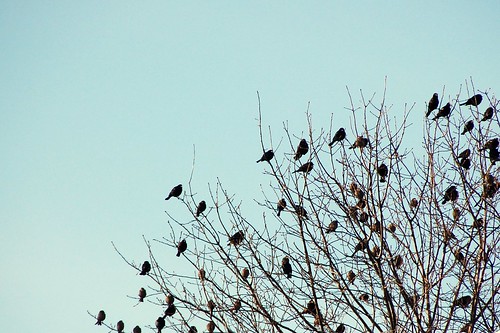
Now, the flock of birds that made their home in the giant tree

towering over this intersection became so used to the chime

of the bicycle bells that it became part of their language.

They spoke it fluently, like natives, even reproducing that

dissonant metallic reverb that truncates the traditional trill.

None could tell it apart from the real thing. And so, in the quieter

moments of earliest morning or perhaps of dusk you might see

a pedestrian twirl around in fright, head swivelling frantically,

sure that at least five angry cyclists were approaching so fast

as to be nearly already on top of him. But in fact there were

no cyclists and the ear-jostled victim would walk on flummoxed.

What is this? Mischief? Such was the ventriloquism of those

birds that no human ever solved the mystery, not one ever even

looked upwards. I knew, of course, but then I’m one of those birds.

Sunday, September 19, 2010


Polonious: What do you read my lord?
Hamlet: Words, words, words.


Here are some words about words:

loganamnosis
noun. - An obsession with trying to recall a forgotten word.

logastellus
noun. - "A person whose enthusiasm for words outstrips his knowledge of them" - John McClellan.

logocentrism
noun. 1 - Literary analysis that focuses on words and language to the exclusion of non-linguistic matters such as the author's individuality or historical context.
2 - Excessive attention paid to the meanings of words or distinctions in their usage hence, logocentric.

logopoeia
noun. [1929 Ezra Pound in New York Herald-Tribune 20 Jan. XI. 5/4] - ‘The dance of the intellect among words’, that is to say, it employs words not only for their direct meaning, but it takes count in a special way of habits of usage, of the context we expect to find with the word... It holds the æsthetic content which is peculiarly the domain of verbal manifestation and can not possibly be contained in plastic or in music.

logocracy
noun. - A community or system of government in which words are the ruling powers.

logodaedalus (or logodaedalist)
noun. - One who is cunning in words.

logodaedaly
noun. - Arbitrary, cunning or capricious coinage of words; skill in adorning a speech; ‘verbal legerdemain’.

logolatry
noun. - ‘Worship’ of words; unreasonable regard for words or for verbal truth

logology (or logonomy)
noun. - The science of words.

logogogue
noun. - A person who lays down rules about words; a language dictator.

logolepsy
noun. - An obsession with words.

logolept
noun. - A word maniac; verbivore, logophile.

logomachist
noun. - One given to disputes over or about words (also logomach).

logomachy
noun. A dispute over or about words; controversy marked by verbiage.

logomisia
noun. - Disgust for certain words.

logopandocie
noun. - Readiness to admit words of all kinds.

logophile
noun. - A word lover or word buff

logorrhea
noun. - Excessive and often incoherent talkativeness or wordiness.

logorrheic
adjective. - Characterized by excessive use of words.

Friday, August 20, 2010


Underlined In Red


Even my heart beats mistakes,
Though one might be fooled by its fakes.
Its hazardous drum couldn’t beat true
By accident. Barely a drum, more a few

Crumbled quiet knockings in my torso
Like drips, bits, blobs, or like crumbs.

A thrum rung crumb, empty lung and still-tongue sung
A brittle crumbeat.
So small it mocks its own large hunger.

But I live through its accents,
All of them wrong.
Shrug in the mire of nonsense
Glum dragged along.

And sing this drugged song

My résumé is fillable with two syllables:
Just one word, wholeness averred:
An iamb that I am:
A noun I take to town:

Mistake.

Friday, August 13, 2010


My Walk To Work


On my walk to work I walk fast. I take big strides and breathe deeply. It is exhilarating. The more I walk, the more I like walking. Walking and thinking.

I am developing a taste for certain types of walking, a distaste for certain others. I love walking uphill – it stretches my calf muscles and gives me a sense of upward progress; greater, higher things await - a prize at the top of the mountain. I dislike walking downhill. My socks rub against my heels and my toes knock against the inside of my trainers. I don’t think I was designed to walk downhill. If hell has a chain gang then they must be constantly walking downhill in shoes that are slightly too large. If heaven has an urban ramblers association they will walk uphill forever. But, of course, I don’t want to walk uphill forever. The urban fluctuations are part of the joy.

I walk with avid determination, overtaking nearly everyone else I encounter. When I notice that someone is walking as fast or faster than me I am immediately charged with a competitive spirit. I must overtake everyone. On the edge of my conscious thought dances the notion that if anyone is walking faster than me then I am being left behind - not merely left behind literally, as I actually am in these cases, but left behind more meaningfully, in life. This is, of course, ridiculous. I am far too competitive. Too often I find myself competing with people who have not the faintest clue that they are involved. One day I will learn to relax. One day.

When I grow up I would like to be able to relax. But for now I must squeeze the day like a sponge. I must vibrate like an atom. I must not waste a second. Every wasted moment stabs into me like a razor sharp hand, or like the chiseled hand of a muted clock - silently ticking; ominously, inexorably eating time, crunching silently, silently – silent except for the ticking, the ticking which I can hear. Tick tick tick...

But I spend an hour walking to work and an hour walking home from work. Two hours of walking every week day? Yes, two hours every day. Are these two hours not wasted? No no; most certainly not. When I walk I am thinking. This is the closest I get to relaxation. The steady rhythm of my deep breathing acts as an antidote to the mas-tick-ating clock, I no longer hear it munching away at time. My steps beat out a glaring defiance that drowns it out – I am walking faster than it can eat, I am moving ahead of time. My legs pulsate happily below me, like my own little animals, working away at the music of motion. So I think, my mind wanders -- wanders and wonders. My eyes rove and watch the passing streets.

Although my walk to work follows the same path every day, things do not stagnate. The fabric of the city is constantly ruffling. I leave my house at 7:30am. This is earlier than most people so the streets are rather empty. Especially the ones I walk through as I begin my journey. John Ruskin Street, Dale Road, Cooks Road, Ravensden Street... they are quiet, residential areas. In particular I enjoy watching the street sweepers.

In autumn I usually see more than one street sweeper. As I approach I notice the leafless prelude to their efforts, the parts they have already swept. And passing directly by them I pay close attention to their skillful use of the large broom. I can’t help but inject a certain heroism into this activity, this art! Sweeping our streets, these men are artisans in a unique way. Watch them. Look you! They are not drones (though by their faces, I fear some think they are), they are not soulless – they possess a honed technique. It is not as easy as it looks – and I love how it looks. There is a real beauty in their sweeping.

Perhaps I’m mad to think so; I know these are not the happiest of men. Not at all. But they are admirable and they are doing something real, something so very real. Perhaps I am too keen on tidiness – and I am very keen on tidiness – or perhaps I give my thoughts too rosy a tint. Yes. Perhaps.

So my walking usually calms the tempest of time, smothers my fear of wastage, and I stride wholesomely on. But sometimes walking is not enough. Sometimes I need to make sure that I feel I am still progressing, learning, building... So to avoid any of that painful time wastage I practice my human beatbox. I make drum beats with my mouth. Secretly, I tell myself, this is part of my project to become a Homo Universalis, a man of broad and varied skills and learnings, a polymath. Or, at the very least, someone who has learnt things, someone who has thought things, someone with interests, passions and skills. Someone full of surprises. Is this a lot to ask? Probably. But I ask this of myself. I can't help it.

Along I walk, beatboxing in time while humming underneath, gasping for breath after four bars, grunting and heaving, burbling, mumbling, almost gurgling sometimes... I beatbox my way through the streets. When I first became enamoured with the human beat, the mouth-drum, I would only practice at home - in the safety and solitude of my room or that of the bathroom (which has good harmonics). But gradually my confidence has grown. It started in Southampton, where I was at university, in the quieter streets there, at times, when I realised no one was near, I would indulge heavily. "Ba boom boom bap, t-ch t-ch boom bap!" Sometimes, when I became carried away, I would suddenly notice someone nearby, perhaps they had just got out of a car or come out of a house, in an instant I would fall silent. But soon I realised that nothing would come of it if I continued, if I held the beat and walked on, not caring whether others could hear. That is not to say that I now beatbox fearlessly in public. There are certain people who can still cause me to fall silent: those who might understand what I'm doing. Young men, for example, especially those dressed in hip-hop regalia, are most likely to know what I am up to with my strange noises. I do not want an understanding ear listening in. My walking beat is a music of solitude. If it must be heard by others I want it to appear nonsensical, mad, foolish, odd... because no one approaches (or for that matter reproaches) a mad man.

Along the three miles of pavement I see many of the same faces every morning. And more often than not I see them at the same point in my journey. I pass a man and his daughter leaving their house to cycle off down the road together, both heavily clad in reflective gear and flashing lights. The father always cycles between his daughter and the traffic at an angle behind her. They roll along peacefully and their punctuality always pleases me - they leave their house at 7:35.

The same fat woman waits for the southbound P5 bus on Dale Road every morning as I pass at about 7:40. She stands reading a book, solitary and absorbed. She is always alone and always reading. I sometimes try to work out what she is reading but can never manage to spy the spine. She holds her books wide open with the spine facing flat to the floor. You'd have to crouch in front of her to see the cover. One of these days I'll crouch down and tie my shoe laces or stoop to pick something up and steal a glance. It struck me recently that, after months of vague scheming and planning how to discover the book I had never thought of just asking her. But this kind of interaction makes me uncomfortable. I imagine she would feel uncomfortable, if not because it is none of my business, then because she might think I was after something else. After all, one doesn't expect people in the street to take an interest in your chosen reading. And I am just a person in the street, as far as she is concerned. I doubt she even knows my face, though I know hers, as she is always engrossed in a book.

As I walk down Ravensden Street, two cyclists unlock their bikes from the railings in front of their houses. The first one is a young woman, and then further down the street, a young man. They both wear helmets and full-body cycle suits of Lycra. Though they are neighbours about 10 houses apart they never speak to each other, they never look at each other. But, walking through like an unacknowledged ghost at 7:45, I look at them and smile. I enjoy their synchronicity with each other and with me.

My walk takes me past two comprehensive state schools (one of which I went to myself). Bopping in droves, I see duplicates of the characters I used to know at school. In particular I notice the boys who would have terrified me as a boy. I used to call them rudeboys. I still do. They haven't changed. But I, thank goodness, have. They no longer terrify me because they no longer see me. I do not exist to them. I am now a man with a beard, an adult, at least by appearance. They see straight through me. This is at once very odd and very liberating. When I was at school I wished so dearly that they would look straight through me and now that they do I can't quite believe it. There are moments when they erupt into boisterousness right next to me on the pavement, hitting each other, swearing, laughing brutally - sometimes I flinch, forgetting myself for a moment, preparing to run away as I would have done 10 years ago. Then I suddenly remember that I am invisible.

At 7:55 I reach Mi6, the fiercely guarded British Secret Intelligence building. Gazing up at the numerous security cameras lining the walls I sometimes catch sight of one that is moving about like a chameleon's eye, scanning inquisitively yet attached to a large and eerily stationary body. About once a week I notice a police officer on the pavement outside, methodically checking all items of street furniture surrounding the building from the bus stop to lamp posts and traffic lights. He wears a big bullet proof vest and squints at every paving slab with dutiful paranoia.

At 8 o'clock I am half way to work walking over the river on Vauxhall Bridge. Sometimes, when a thick morning mist drapes itself over the city, the bridge disappears into a spectral nothingness. The opposite side of the river is barely visible and the bridge looks as if it might continue indefinitely, stretching over a quiet ocean. Reaching the middle of the bridge is thrilling in the mist: neither side of the river are quite visible and the growling grey metropolis momentarily evaporates to leave me walking through a cloud.

Pimlico's opulent white houses surround me for the next episode of my walk and for the most part, I walk alone. The ludicrously rich inhabitants of this area are to be seen scurrying from their front doors into their luxury cars with their ridiculously uniformed children. I don't understand why Chelsea's private primary schools insist on clothing their students in almost theatrically dated outfits. Three year olds in breeches and berets, or tiny suits with cuff links. I'm probably exaggerating. But not much.

On Pimlico Road at 8:20 I pass the same beautiful woman every morning. She walks determined and fast, looking down, with a slightly pained expression on her face. I always hope she'll look up at me, at which point I plan to smile and thereafter... well, of course, we'll get married. I haven't figured out how my smile leads to marriage... fill in the blanks yourself and let me dream. She's so beautiful. But, as far as I know, she has never set eyes on me. My unrequited encounter with her signals the beginning of the Pimlico Road interior design district.

Shop after shop exhibiting cabinets, tables, chairs, and endless household items of absolutely no function whatsoever adorn carefully arranged window displays. None of these shops are open at such an early hour. But, positioned in the centre of this district of finery, lies Daylesford Organic, a cafe of sorts (though I'm sure "cafe" would strike both the staff and the clientele as far too vulgar a word to be appropriate here). Pampered dogs sit patiently beside botoxed woman of indistinguishable age, and impeccable make-up. Ineffably clean business men sit sipping coffee and reading the newspaper over an eccentric looking pastry.

Sloane Square hits with a sudden bustle and my quiet walk is over, my beatbox must stop. My legs are gratefully worn out, they surge with a glad fatigue as I slow down to weave through the crowds. The throngs push towards the tube station and I salmon against them, eventually slipping into the back door of my workplace. I am damp with sweat.

The oil company is rich and the offices are accordingly plush. The toilets and showers are what you would expect from a 5 star hotel. I've never been to a hotel but I know what I would expect from a 5 star one. The shower room is large enough to swing a cat in - a tiger. Blindingly clean white towels are provided. They are piled up on the bench neatly folded. There is a sink and a toilet beside the shower cubicle. Everything that could possible sparkle does sparkle and the walls are panelled with what looks and feels like marble. It probably is marble. I never get used to the sight of myself in the mirror peeling off my damp old t-shirt and removing my worn trainers in this majestic environment. I don't feel I belong there. This shower looks as though it were designed to wash people who are already immaculately clean.

Tuesday, July 20, 2010


Divine Contradiction


Not as divine as we all thought, one afternoon God fell to drinking. He had been a rigid abstainer for the past eternity but something, He felt, had changed. Something about the universe seemed different. There was something down on earth that they called postmodernism. It didn't so much feel like an affront on religion as many past movement had been. No, God had been reading some of these confusing postmodern texts. God felt as though His creation had produced something alien. He wondered, indeed, if these philosophers were not the spawn of some other deity. But of course not, He told Himself, I'm omniscient aren't I? I would know about that. Nonetheless, postmodernism was unnerving. These philosophers were not worshiping false Gods, they were affirming the omniprescence of contradiction, they were denying the possibility of truth... the enlightenment was falling apart but the secular were not returning to pious worship of mysterious symbols. Not quite. Those that did a lot of thinking, these philosophers, were discovering chaos, confusion, and uncertainty where before everyone had been certain that truth was hiding somewhere, the scientists would find it. No longer. It wasn't that science had died, far from it. It was philosophy that was dead or dying. Philosophy as the practice of seeking truths, arriving at truths, was being left behind, discredited. Philosophy was about ... what was it about? That was moot. But one thing was certain, and that, unfortunatly, was uncertainty.

So God, having noticed this with increasing alarm, decided that something must be done. But rather than conduct a miracle, God thought He might join in. He wasn't so sure He knew everything after all. For example, what would happen if He had some alcohol? He didn't know. There was no one to ask, no one knew more than Him about the universe but there were no clues as to what might transpire if a God became drunk. Moreover, was it a sin if He had a drink? He'd never considered such a thing posssible. The logic was becoming rather foggy here and He was beginning to sympathise more and more with this postmodernism malarkey. Contradictions were cropping up everywhere, why had He not noticed before? For example, His ignorance of the effects of alcohol on His transcendent body, despite His being omniscient, that was a contradiction wasn't it? An ignorant omniscient? He wasn't even sure.

So it didn't seem completely insane to try a drop of alcohol now, to partake in a bit of this confusion and perhaps maybe even understand it a little, if that made sense. Chosing at random He poured Himself a glass of sherry. It seemed to emanate a certain majesty that was fitting considering His presidency of the universe. Without much trepidation He raised the glass to His lips and took a sip. Its sharp bitterness was an unfriendly element in His mouth and He frowned thoughtfully. As the initial tang wore off and the drug hit home God leant back in His chair. There was something cathartic about this unpleasant liquid. Despite the taste He could see the appeal. Engaging so tangibly in a contradiction, as He felt He was, His thoughts turned again to the philosophers. The possible enormity of what He was doing did not seem to worry Him. Perhaps this was a new era. The paradox was no longer a freak accident, a bearded lady or two headed featus. No. The paradox had become a fashionable object. A kind of monacle through which to squint at existence. And who was to tell God that He couldn't have a go with this monacle?

Taking another sip of sherry, God looked down on the world from heaven and suddenly felt old. This alcoholic excursion... was it foolish? Was He like the middle aged parent who learns some slang to impress the children? This possibility depressed Him and, somewhat carelessly, He drained the glass. As it burned down His throat He inhaled sharply and found Himself murmuring "No one else will know anyway. I'll just have a few drinks and stay out of the way for the evening. What harm can it really do?" A questioning look appeared on His ancient face and He seemed to be asking himself something. "Why have I started thinking aloud?" He continued, "I suppose it must be something to do with this sherry. I better have some more... to be.... to be sure."

Thursday, June 24, 2010


Ship


But this is a mess. I need some structure. We need structure.

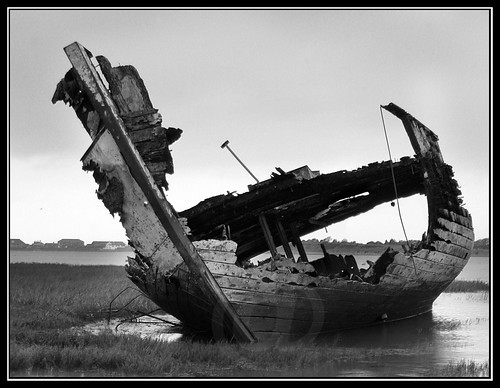
Help me dredge up the structure of this old boat from the bottom of the ocean. This algaed carcass of a ship, for years a playground for the fish, will structure my story. Help me drag it from the depths and as we heave, I’ll tell you some things. Listen.

I wish I could speak but dyspepsia holds my tongue. I feel such a weight of tales, such a full stomach of words that I might vomit you a whole book, a library of ink.

Be patient. I will get there.

This boat – and we are heaving it, yes we are – is drippingly emerging from the clouded waters. Heave ho. And your muscles are strong. You are a good heaver. You tug like a veteran ship salvager. But keep your focus and I shall sing.

My song will keep our sinews well oiled. Oh look at the proud old ship! Even its drying drips are wondrous. Look how it retains its glory even after so many years entombed in that liquid Hades. But I was going to sing. I will sing.

Heave hoe, the reaper mows
And as he goes with timely blows
The wheaty ears are blasted.

Heave hoe, the gentle mice
Like scuttling lice, or rolling dice
Flee full-tummed unfasted.

Heave hoe, those earthy greens
Do still beteem, by nature’s wean
Ne’er letting death hold sway

Heave hoe, on nature’s road
Some will be toads, some sing fair odes
And some will do what may

As this old wooden beast gains its renaissance into air we smell its salty promise... while my promises of tales to charm your ears remain yet unfruited. I must needs stop stopping and get on with starting to start. So stand back.

No, not so far back as you can’t hear me over the roar of the creaking vessel (as it inches glacier-like). Thats right, legs firm and keep up your tugging, for I can feel the start of a tale coming on. And what a tale I have to tell.

Oh but look how the gulls - how they hover and swoop, plunging their beaks into the marine foliage, replete as it is with the bugs and mites of the deep. From this uprooted civilisation they pluck in their beaks the spongy, slimy creatures whose eyes, if they have them, are blinded by the first-time-seen sun, and whose lungs, if they have them (or something like them) are drowned in the caustic breezes of the super-marine world. Dazzled and shocked, these wrigglers squirm and recede, trying to hide clam-like in the algal sludge which this doting ship wears like a dressing gown. But plucked they must be, for the gulls are hungry and have no mercy on this chewy treat, no sorrow for this rare and delicious game.

I should focus. You should check me in my digressions. I grow old. Indeed, I forgot myself and my professed readiness to tell tales. I saw the elegant gulls and forgot myself. But you can forgive me, can you not? These gulls playing and pecking at the whale-like hulk: few sights have entered my eyes so majestically. Surely the wide-eyeing majesty of the Now – and not just any now, these gulls, this particular compelling Now – trumps the dustiness of the Used-to-be. Who can cast their thoughts into the distant land of past events? – Who can do this when muscles wrench at a thousand ropes and chants of “heave” have scarcely fallen dumb when they return with redoubled potency, when a historic floating beast of old rears its sleepy head at our cajoling tuggery?

But lo! The Now strikes again – look! The cavernous underbelly of the ship revealed, slowly rising from the water, and we see inside the cabins. A shabby cross section washes into view, rotten timber fallen away here and there to reveal glimpses of the domestic innards. Is that not an old desk, three legged with age, carbuncled with the many kisses of the subaqueous salts? Yes, by jove! An old desk! How startling to see such a familiar thing so changed, do long dunked and forgotten in the colossal bucket of the seas.

But forgotten no longer. We remember you, oh joyous desk of old. It is broad and sturdy, even in its ruined posthumos-ity. I’d wager these were the captains quarters! What think you on’t? And what treasures might there be, of gold and olden silver, of faraway climes and lost tribes. I tremble just to think.

But that was my tale, I see it now. It crept in under the door, all stealth. I’ve told my tale. All the while stopping and starting, ever digressing and circumambulating. But it seeped through - a crafty osmosis! The beans are spilled. The cat is out.

The sprightly goblin dances no more (nor jives the goblinly sprite!)

You see: I told it all in the not-telling. I spoke it in the nods and winks, in the gaps, in nonsense. It was between the lines - between the ropes!

Words but grab at meanings true
Feeble in their violence
Living holds the flowing you
And the rest is silence.

Tuesday, June 22, 2010


Pangrams


A pangram is a sentence that uses all of the letters of the alphabet. The most famous English one being “the quickbrown fox jumps over the lazy dog”. For pangrammatists the ultimate quest is to find a sentence that contains each letter only once. This is known as a perfect pangram. There are a few in English but they make very little sense to anyone but the most absurdly well-dictionary-read lexophile. Here are two examples of perfect English pangrams, with explanations of the meanings in brackets below:

· Cwm fjord bank glyphs vext quiz.

(Carved symbols in a mountain hollow on the bank of an inlet irritated an eccentric person.)

· Squdgy fez, blank jimp crwth vox!

(A short brimless felt hat barely blocks out the sound of a Celtic violin.)

These perfect pangrams may strike most people as ridiculous and pointless achievements but as they become slightly longer, letting in some repeated letters, the hunt for pangrams produce some wonderfully odd sentences that we might never otherwise have the pleasure of considering. Take for example this Bulgarian pangram:

За миг бях в чужд плюшен скърцащ фотьойл.

(For a moment I was in someone else's plush squeaking armchair)

Or this French one:

Voix ambiguë d'un cœur qui au zéphyr préfère les jattes de kiwis.

(Ambiguous voice of a heart which prefers dishes of kiwis in the breeze.)

It seems to me, though I am very likely indulging myself in a ridiculous thought, that if they contain every letter in the alphabet then they must be saying something universal. If they are built of every type of particle in the known communicative landscape, surely they will be a kind of unifying patchwork quilt of representation that speaks of and for all the letters, for the language, for that culture’s communication itself. If you look deep enough into the pangram you will see an entire culture. Its reverberations will ricochet out of it from every letter like a thousand balls bouncing madly out of a swirling arrangement of ink. The typography of an alphabet itself, which will be necessary for it viewing (though even Braille has a design!) already gives away loudly whispered secrets of the culture. Look again at your language in its most reduced form, a single letter. Look at the tincture of a word, the letter a. Look at its handsome form, and how the ink curls about it lovingly. This is the ink’s favourite pastime, indeed, its passion. Ink loves nothing more than to form letters on the page. When we form a word in our mouths and on our faces the explosive complexity is of course to be celebrated. But ink lives for text. ‘Words dazzle and deceive because they are mimed by the face. But black words on a white page are the soul laid bare’ Guy de Maupassant.

Our words dip their bare feet in ink buckets and walk the papers of our diaries. Our thoughts leave inken footprints. And where there is no ink, our thoughts must leave some marks somehow. Just as Ahab’s peg leg leaves dents in the deck, his thoughts of Moby Dick bechisel his forehead:

‘Soon his steady, ivory stride was heard, as to and fro he paced his old rounds, upon planks so familiar to his tread, that they were all over dented, like geological stones, with the peculiar mark of his walk. Did you fixedly gaze upon that ribbed and dented brow; you would see still stranger footprints – the footprints of his one unsleeping, ever-pacing thought.’

-Herman Melville, Moby-Dick.


Idleness


Idleness is, I think, our greatest passion. Industry is, surely, a disease. It is an itch upon our souls. A lolling rest is what best suits us; a sated, head drooping, floppy-bodied decumbency. So why am I not taking advantage of my freedom and lolling in some corner in worship to this ideal (or idleal, you might say, but this tongue-challenge may be too much effort for a true idler) why, you might ask, am I sat defiantly upright at the computer tapping away in a frenzy when I could be lazing in any number of positions elsewhere? Well, I’ve caught the disease. I’ve got the itch. I’m a sufferer of the animating impulse that drags our yawning souls from rest and pokes them into action, shoots at their feet to make them dance, showers them in itching powder that causes an itch so dire that it can only be relieved by a most furious industry. So here I am, writing. Un-idled.

But not for long, I feel my gut murmur, not for long will you toil. No? I question. But I can’t help it. Even when I resign myself to a stretch of relaxation, a period of placid inaction, the itching begins and how smart a lash that whip can give. No sooner have I leaned back on a sofa, gazed off out the window and let my eyelids do what they will, than the distant sound of a conceptual police siren can be heard, buzzing about my innards. These police live in my psyche and it is their chief aim to keep me as busy as possible. This, they believe, if they can be said to believe anything, is the finest state for a body to be in: industry, toil, labour, action. Couched in the depths of my unconscious they rest their bones when I am in toil, or they sit about playing cards in the station kitchen, brewing endless teas and coffees, discussing the weather in monotones of wagging insouciance.

But when I try my hand at this, when I even think of such loose behaviour, lights and buzzers begin to flash and whirr on their dashboard and they drop their cards mid-hand, leaping up into sanctimonious alert. Drinks are left to steam themselves out of desirability, hammocks hang inert, and cards fade in the cultural vacuum of ruler-less splay. Into their cars they leap and out of the murk they drive, out into my conscious mind they venture with powerful flairs, megaphones and placards, with harpoons, guns and grenades. They’ll do anything to wake me from my stupor and prick me into action. A modern day Gulliver I have become, whose Lilliputian superego plagues him from the inside in systematic formation. A single ant is as ineffectual as a single member of this constabulary. But just like ants, these officers of my psyche can get to work with marvellous potency when they work in concert. It is unbearable. I feel like the captain of a ship whose deceased mutinous crew have, ghost like, inhabited his body and are driving him which way they will.

So I don’t let myself idle much. It keeps them happy. Instead, I urge myself on. I whip myself inwardly, thrash my hide viciously, lest I become complacent and start to linger or loiter over some trifle. Yes, I beat myself up. As the anarchists like to joke “Help the police: Beat yourself up”. They may joke about it but people do it. People really do. From the inside.

And time passes without a care in the world for what it passes. It simply strides on. It does shock me sometimes when I consider it. Time just keeps on ticking and tocking and moving forwards. There’s no stopping it. So staunch and unstoppable. It plows on without asking for or needing anyone’s permission, without any support. Whether you condemn it or make it an object of your worship, it trundles along like some massive whale whose immensity will not allow for any change in momentum. If you pay no attention whatsoever, on it goes.